You pick up a blue lamp at a craft fair. The seller says it is Khurja pottery. The glaze looks deep and shiny. The tag only says “ceramic”.
Back home, you look for the same lamp online. One listing says ceramic in the title, but its material line says glass. Another says ceramic, and its material line says PLA.
So what are you buying? Pottery from Khurja is real Indian craft, about 600 years old. Many lamp listings that borrow its look do not say what the lamp is made of. The same question is worth asking of all decorative lamps, not just pottery ones.
Below, you will see what the town makes, the numbers behind the town, and what we found in 28 ceramic lamp listings.
The short answer
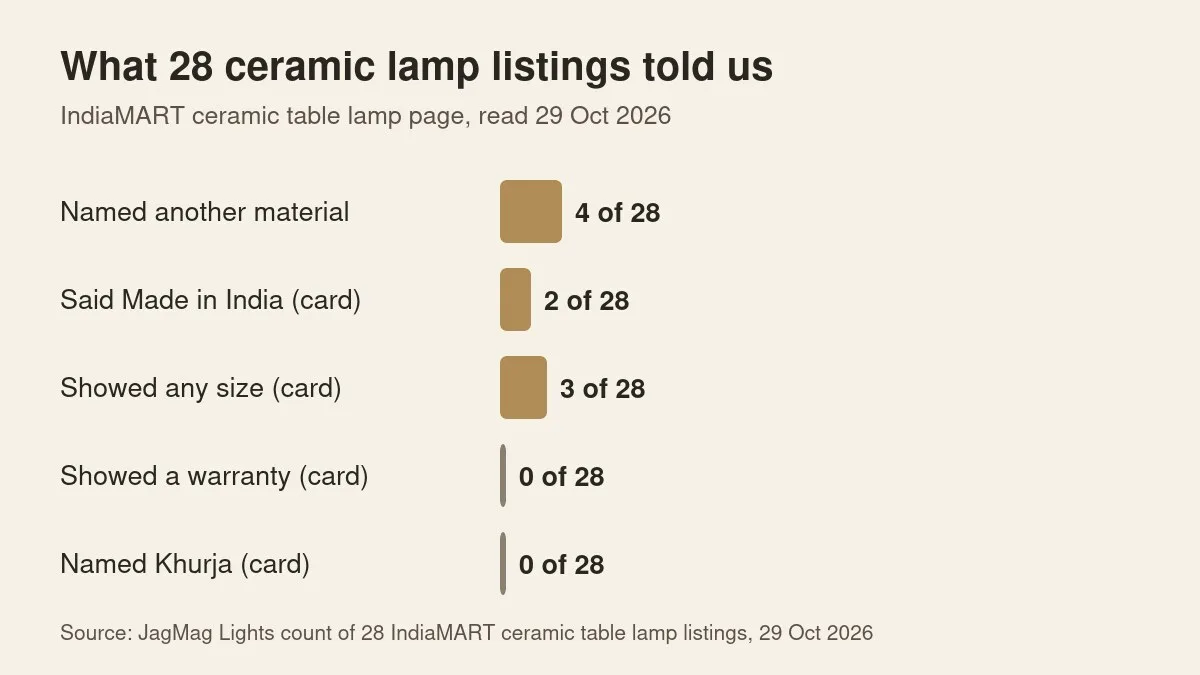
Khurja pottery is glazed ceramic from Khurja, a town in Bulandshahr district of Uttar Pradesh, protected by a GI tag since 23 March 2015. Real ceramic is clay fired in a kiln at high heat, while PLA, a plastic used in 3D printers, starts to soften at about 60°C. We read 28 ceramic table lamp listings on 29 Oct 2026. 4 named a different material in their own material line, so read that line before you pay.
What is really going on with Khurja pottery
Khurja is a pottery town with a long memory. Here are the numbers.
- About 600 years old: India’s tourism ministry dates the craft to almost 600 years ago, to potters who came from Multan.
- GI tag in 2015: the Khurja Pottery Manufacturers Association filed on 6 July 2009. The GI Registry registered it on 23 March 2015, valid to 5 July 2029.
- 500 to 1,000 units: the tourism ministry counts over 500 factories. ETV Bharat reported 800 to 1,000 units in July 2026.
- About 25,000 workers: plus 5,000 to 7,000 people in support work, says the tourism ministry.
- 45 countries: Khurja ceramics go to more than 45 countries, including Japan, per ETV Bharat in 2026.
- Our study: 4 of 28 ceramic lamp listings we read named glass, metal or PLA in their own material line.
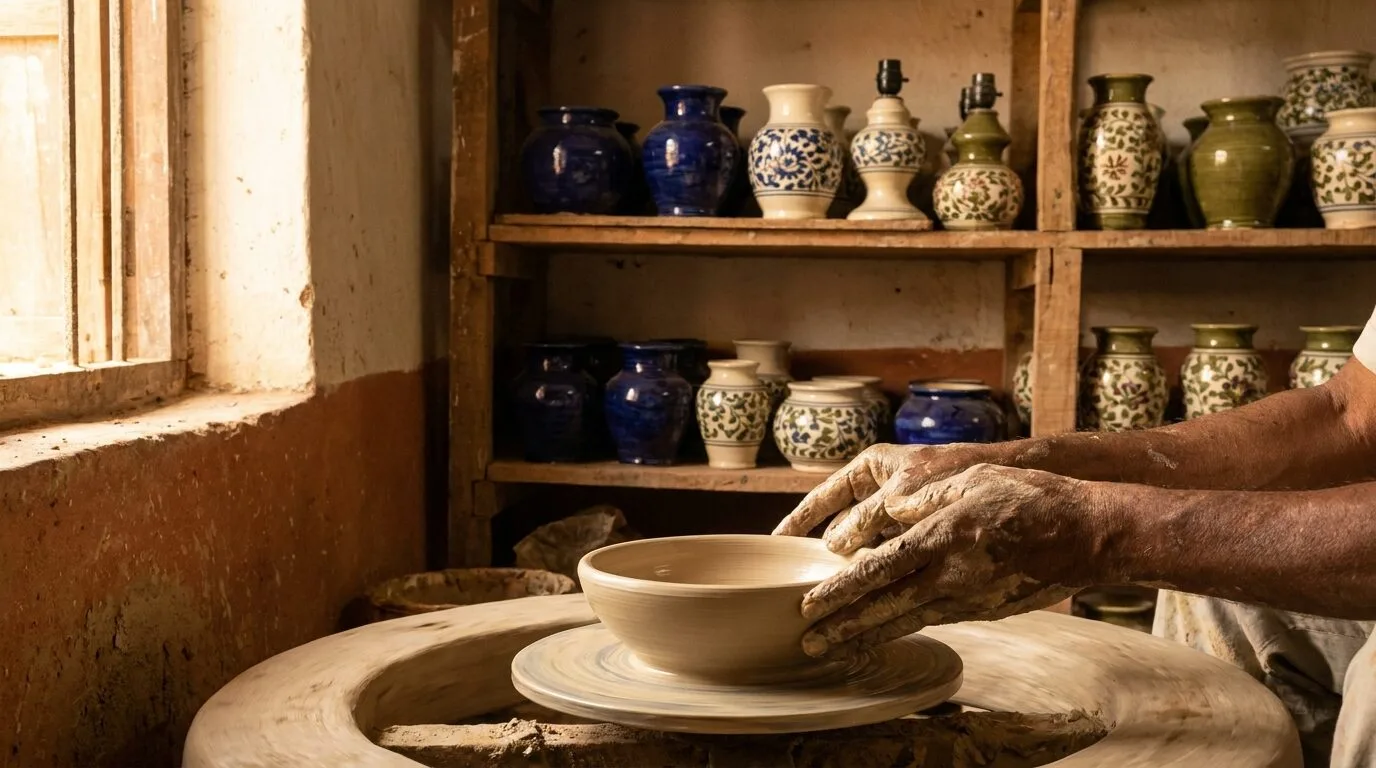
Khurja potters start with local white clay, called safed mitti. They mix in quartz and feldspar, two crushed stones from Gujarat and Rajasthan. Then they shape each piece by hand or machine.
The painting comes next. Khurja is known for floral patterns in blue, green, red and brown, often with a black border. A glaze, a thin glassy coat, goes on last.
The kiln makes clay into ceramic. Stoneware, the dense kind of ceramic, is fired above 1,200°C, says the clay maker Potclays. PLA softens at about 60°C. 1,200 ÷ 60 = 20, so a stoneware kiln runs 20 times hotter than the heat that softens PLA.
The town is big and busy. 25,000 workers ÷ 500 factories = about 50 workers per factory. With 1,000 units, the same 25,000 workers gives about 25 per unit, so most units are small workshops.
The GI tag took time. From 6 July 2009 to 23 March 2015 is 2,086 days, about 5 years and 9 months. The tag protects the name “Khurja Pottery” for goods really made there.
Khurja has sold for a long time. Figures cited on Wikipedia show the town made goods worth about ₹250 crore in 1999-2000. About ₹14.8 crore of that was exported. ₹14.8 crore ÷ ₹250 crore = about 6% sold abroad.
How to check a ceramic lamp yourself
These 5 checks take a few minutes, in a shop or on a phone.
- Read the material line on the listing, not only the title. The title and the material line should both say ceramic.
- Ask if the base is fired clay. PLA starts to soften at about 60°C, so a plastic base should not sit close to a hot bulb.
- Ask for the height and width in centimetres. Only 3 of the 28 listing cards we read showed any size.
- Ask where it was made. The Khurja name is protected by a GI tag, so ask which town and which unit made the base.
- Ask about the parts: which bulb holder it takes, and who sells a new shade or base if one breaks.
We read the 28 listings on IndiaMART’s ceramic table lamp page on 29 Oct 2026. 4 of 28 named a different material in their own material line: glass in 2, metal in 1, and PLA in 1. On the listing cards, 2 of 28 said Made in India and 0 of 28 showed a warranty. 2 sellers were based in Khurja, but 0 cards named Khurja in the product text.
Side by side
| What you care about | JagMag ceramic lights | The 28 listings we read |
|---|---|---|
| Material named | 6 of 6 say glazed ceramic or porcelain | 4 of 28 named another material |
| Where it is made | India, on 6 of 6 pages | Made in India on 2 of 28 cards |
| Size given | Height and width on every page | Any size on 3 of 28 cards |
| Warranty | Lifetime rust warranty on the steel | Shown on 0 of 28 cards |
| Spare parts | Kept for 10+ years | Not stated |
Where the other side is better
Khurja is far bigger than us. The town has 500 to 1,000 units and about 25,000 workers. We make 6 ceramic lights out of 420.
The range and the colours in Khurja are wider, and its potters have 600 years of practice. If you want a large set of hand-painted blue pottery, a good Khurja unit is a fine place to go.
What we do at JagMag
JagMag Lights, a decorative lighting manufacturer in India, makes 6 lights with real ceramic. Each page names the material, the size and the bulb holder. 6 of our 420 lights = about 1.4% of our range.
Take our glazed ceramic table lamp with a gourd base. The base is clay, shaped, glazed and fired in the kiln, so the deep blue glaze moves a little on every piece. The lamp is 70 cm tall with a 38 cm cotton drum shade and an E27 holder; bulb not included, so fit a 3000K warm-white LED.
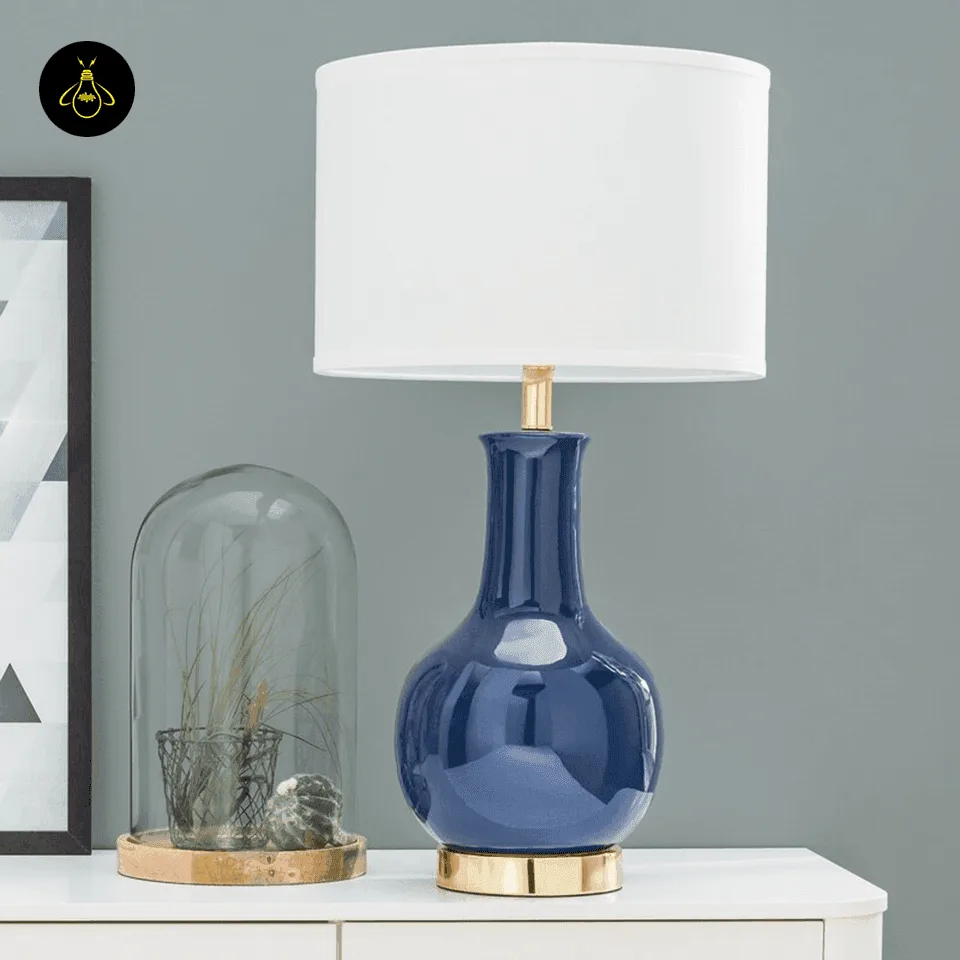
The foot and neck are 304 stainless steel, the same grade as a good kitchen sink. Our Legal Policies, clause 4.1A, give the steel a lifetime warranty against rust for orders from 4 October 2026.
Our ceramic also goes into light. The ceramic ginkgo leaf chandelier is 85 cm wide, with every porcelain leaf shaped, glazed and fired by hand. The stacked ceramic table lamp is 90 cm tall, with 6 glazed rings under a linen shade.
On our 80 cm ginkgo chandelier, each leaf is shaped from clay, glazed by hand and fired, then set on its branch one by one. We have made lights in our own factory since 2015. We keep spare parts for 10+ years and make a custom finish in 15 to 20 working days. Clay from the earth and warm light ground a room, the kind of harmony Vastu thinking has always valued.
Want more on real materials? Read our guides to Indian artisans, handmade lamps and artificial marble.
FAQs
What is Khurja pottery?
Khurja pottery is glazed ceramic made in Khurja, in Bulandshahr district of Uttar Pradesh, with a tradition of about 600 years. The craft carries a GI tag, registered on 23 March 2015.
Why is Khurja famous for pottery?
Khurja is famous for hand-painted, glazed ceramic made in over 500 factories by about 25,000 workers. Its ceramics sell in more than 45 countries.
How can I tell if a lamp is real ceramic?
Read the material line on the listing, not only the title, and ask if the base is fired clay. Of 28 ceramic lamp listings we read on 29 Oct 2026, 4 named glass, metal or PLA in their own material line.
Does Khurja pottery have a GI tag?
Yes, the GI tag is application number 178, filed on 6 July 2009 and registered on 23 March 2015. The registration is valid until 5 July 2029.
Does JagMag make ceramic lamps?
Yes, JagMag makes 6 lights with real glazed ceramic or porcelain, including a 70 cm table lamp and an 85 cm ginkgo leaf chandelier. Each has 304 stainless steel parts with a lifetime rust warranty.
Nature gives the material. Human hands give it meaning. Light brings it to life. That is JagMag.
See our table lamps, our bedside table lamps and our dining room chandeliers. Not sure which suits your room? Video-call us.
Sources
- Incredible India (Ministry of Tourism), Khurja pottery (read 29 Oct 2026)
- GI Registry, application 178: Khurja Pottery (read 29 Oct 2026)
- ETV Bharat, Khurja presents its trademark ceramic pottery in new avatar, 26 Jul 2026
- Wikipedia, Khurja pottery (1999-2000 output and export figures)
- Potclays, the difference between stoneware and earthenware
- MakeItFrom, PLA material properties (glass transition 60°C)
- IndiaMART ceramic table lamp listings (28 listings read 29 Oct 2026)