
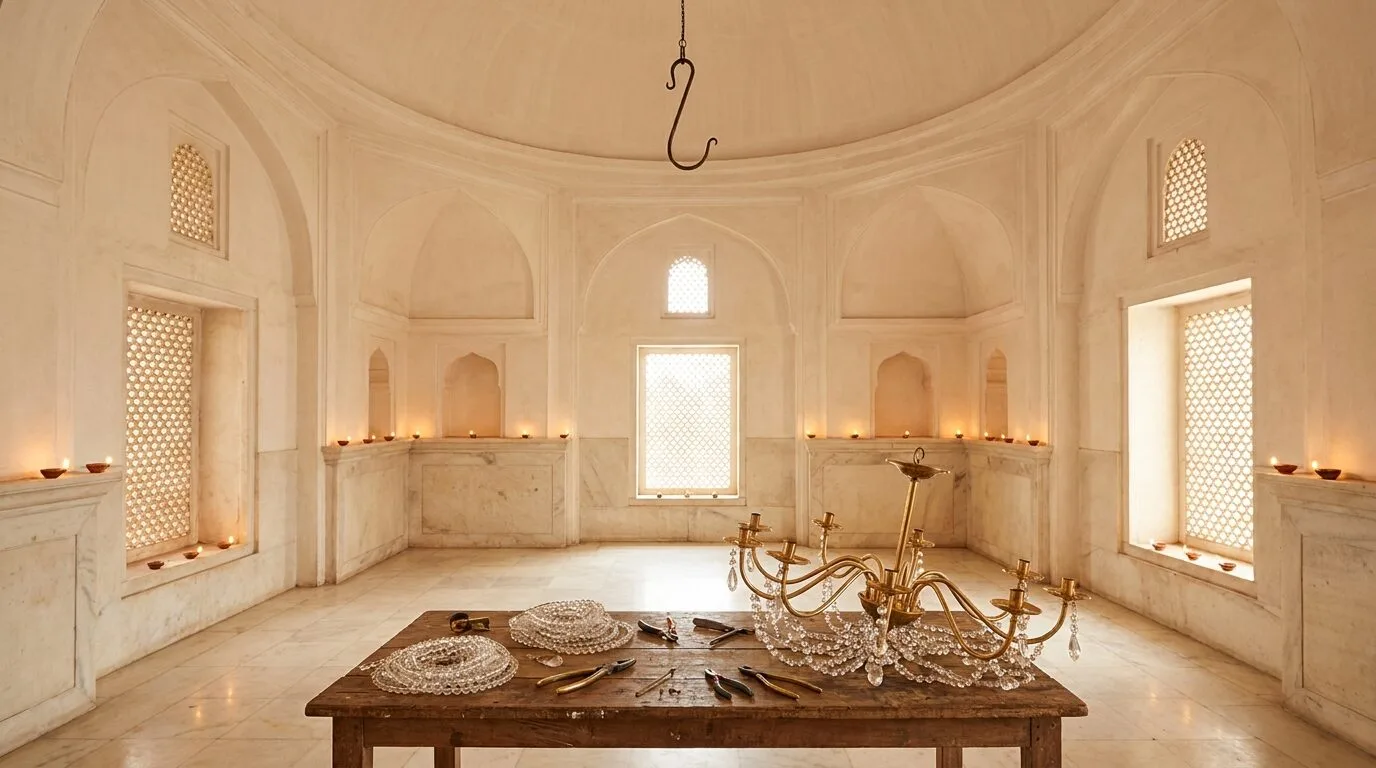
The new temple hall is almost ready. White marble on the floor. A tall dome above. The committee meets on Sunday to pick the last thing: the chandelier.
A trader brings a thick catalogue. Hundreds of photos. Point at one, he says, and the order goes to a factory abroad.
Two questions stay in the room. Will the photo fit our dome? And if a crystal string falls in five years, who sends the matching one?
A chandelier for temple use will hang for twenty or thirty years. Below, you will see how a made-to-order piece compares with a catalogue import, and what to ask before you sign.
The short answer
For a temple, gurudwara or dargah, choose a chandelier made to order by a maker in India. The maker can size it to your dome and keep spare parts for the long life of the hall. Custom pieces from our factory are ready in 15 to 20 working days.
What is really going on with a chandelier for temple halls
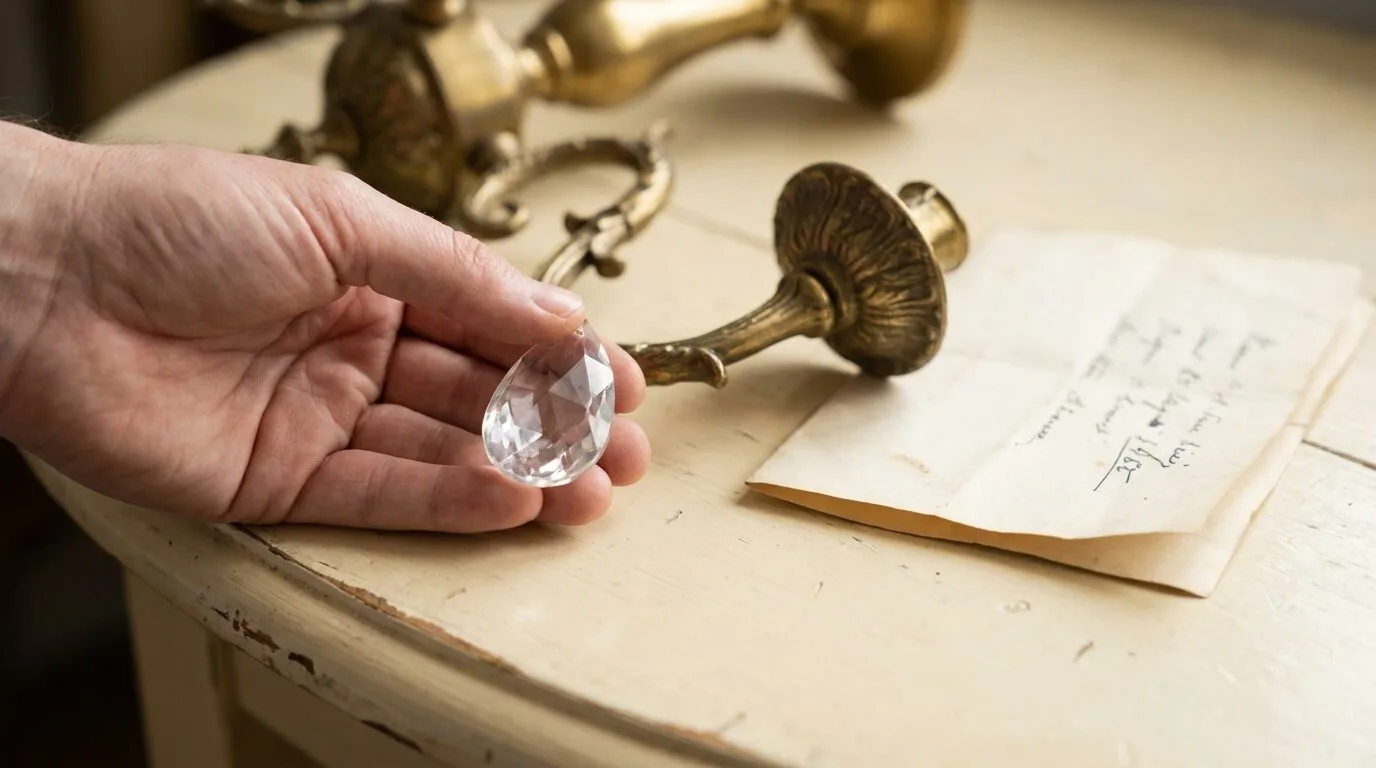
A place of worship keeps its chandelier for decades. Over those years, things happen. A crystal string breaks during cleaning. An arm gets knocked by a ladder. A bulb holder wears out.
Every repair needs the exact part. The same crystal, the same arm, the same glass shade. The repair depends on one question: can the person who made it make that part again?
Imported lights in India mostly come from one country. TrendEconomy trade data shows that about four of every five lamps and light fittings India imported in 2023 came from China.
A catalogue import is made in a far factory for many buyers at once. The trader who sells it did not make it. When a part breaks, the trader must ask that far factory. By then, the factory may have changed the design.
A maker in India keeps the drawing, the frame size and the parts list. The maker can cut the same arm again and string the same crystal again. The maker also picks up the phone.
So the real choice is not about the photo. The real choice is about who stands behind the chandelier for the next thirty years.
How to check it yourself
- Read the “Country of Origin” line on the box, the bill or the online listing.
- Ask who made the frame, and get that maker’s name and address on the bill.
- Ask in writing which spare parts are kept, such as crystals, arms and glass shades, and for how many years.
- Ask for a drawing with the height and width made for your dome, not a catalogue size.
- Ask for the warranty in writing, and check what part of the chandelier it covers.
With those answers in hand, the two choices look very different.
Side by side
| What you care about | JagMag, made to order | Catalogue import |
|---|---|---|
| Size and shape | Made to fit your hall | What the catalogue offers |
| Time for a custom piece | 15 to 20 working days | Often 60 to 120 days |
| Spare crystals and arms | Kept for 10 years and more | Ask the seller in writing |
| Who made it | Our factory in India | A factory abroad |
| Rust on the frame | Stainless steel, lifetime rust warranty | Ask what metal it is |
A catalogue import still has real strengths, and you should weigh them.
Where the import is better
Variety. Traders told China Daily in 2023 that imports win on variety. A catalogue can show hundreds of designs in one sitting.
Cost on standard designs. Shop owners in Delhi’s Bhagirath Palace market said the Indian-made version of many decorative items can cost two or three times more.
Ready stock. If the exact design is already sitting in a warehouse, you skip the making time.
So if your hall needs a standard design and you do not mind the spare-parts risk, an import can work. If the hall needs a special size, a sacred shape or a part in fifteen years, a maker wins.
What we do at JagMag
We have made lights in our own factory, Uttar Pradesh, since 2015. Places of worship are some of our proudest work. Every custom chandelier is drawn for the hall first, then built.
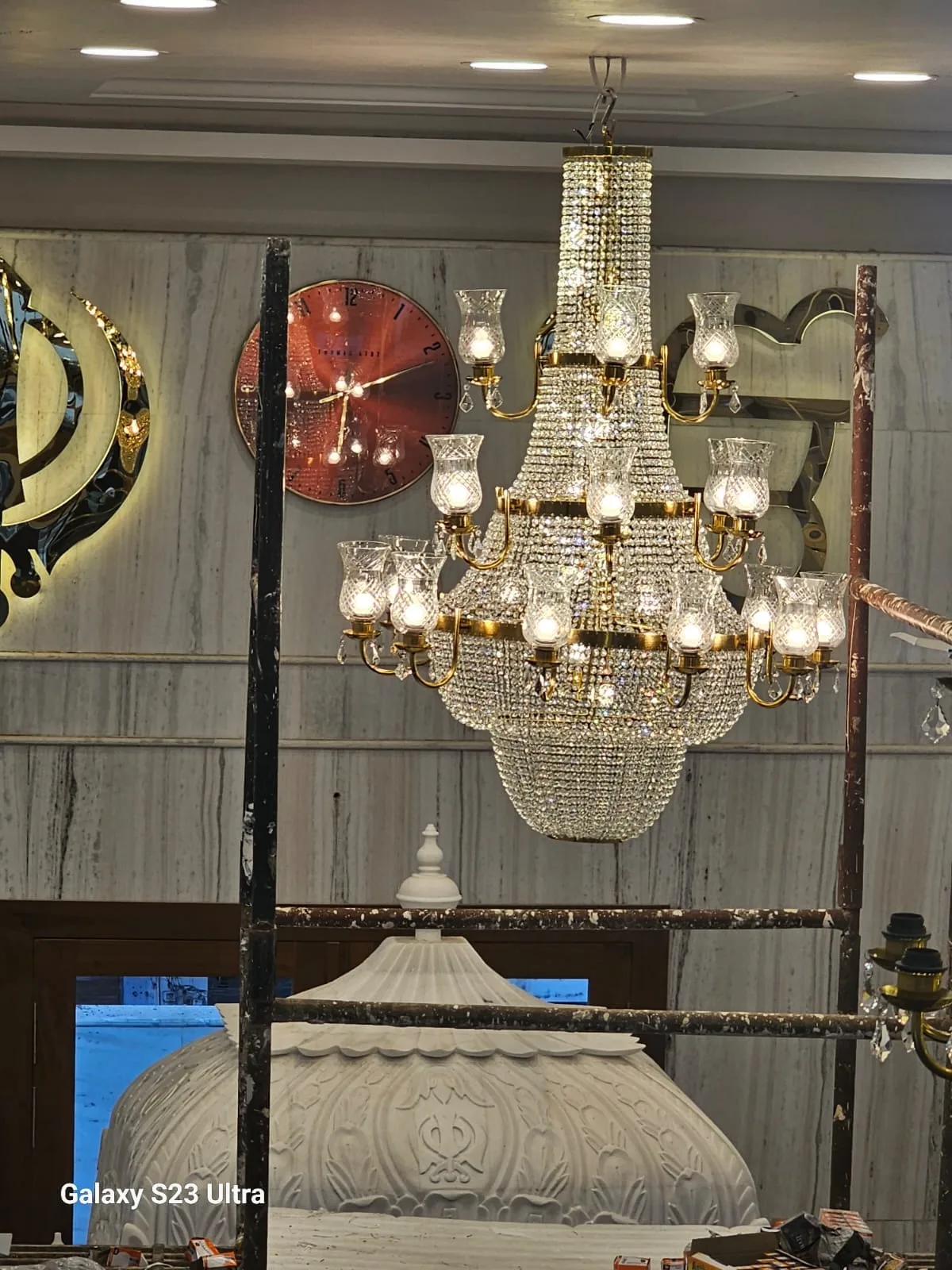
At Gurudwara Shri Prabhu Prem Seva Devi Saheb in Jalna, we made four Maharaja-style crystal chandeliers. The frames, arms, shades and crystal dressing were all made in-house. Our team then hung and dressed each chandelier strand by strand, standing on scaffolding.
The Blunt Times reported that we made a ship-shaped crystal chandelier, 15 feet long, for Hazrath Peer Anwaar Alisha Dargah near Vellore. Building it took a month. Our team also made a Khanda Sahib chandelier in coloured crystal. The chandelier was fitted under a low dome at Gurudwara Sri Guru Singh Sabha, Ghaziabad.
At the SKA Divya Towers society mandir in Greater Noida West, a crystal basket chandelier glows with warm light above the aarti. In a mandir, warm golden light also suits Vastu thinking, which values harmony between light and space.
Custom pieces today come with 304 stainless steel metalwork, the same grade as a good kitchen sink. Our Legal Policies give the steel a lifetime warranty against rust, for orders from 4 October 2026. We keep chandelier spare parts, such as crystals, glass shades and arms, for 10 years and more. Our certifications page lists our CE, UL and ZED marks and DPIIT recognition.
For a home mandir, a smaller light works better; see our pooja room lighting ideas. To understand fixing an old chandelier, read our chandelier repair guide, and our Chinese chandelier vs made in India comparison.
Shopping now? Lighting a home mandir instead? See our mandir lights, sized for a small pooja room.
FAQs
Which chandelier is best for a temple?
The best chandelier for temple halls is a crystal chandelier with warm light, sized to the dome and made by a maker who keeps spare parts. Ask for a drawing and a spares promise in writing.
How long does a custom temple chandelier take?
A custom temple chandelier from JagMag is ready in 15 to 20 working days once the design is final. Importers usually quote 60 to 120 days for the same kind of work.
Can a chandelier be made in the shape of a religious symbol?
Yes, a maker can build a chandelier in a sacred shape from a drawing. We have made a Khanda Sahib chandelier for a gurudwara and a ship-shaped chandelier for a dargah.
What colour of light suits a temple or gurudwara?
Warm golden light suits a temple or gurudwara best, close to the colour of a diya flame. Harsh white light can feel cold in a prayer hall.
How do I know if a chandelier is imported?
Read the “Country of Origin” line on the box, the bill or the online listing. Indian rules require online sellers to show the country of origin.
Can I get a chandelier for a mandir, or a mandir jhumar made to size?
Yes. A chandelier for a mandir, or mandir chandelier, is what many families call a mandir jhumar. We make one to the size of your temple hall or home mandir in 15–20 working days, in our own factory. Send us the ceiling height and the hall width, and we suggest the drop and the number of lights.
Nature gives the material. Human hands give it meaning. Light brings it to life.
See our crystal chandeliers, or send us your hall drawing for a custom piece. Not sure where to start? Talk to us on WhatsApp.
Sources
- TrendEconomy: India imports of HS 9405 lamps and lighting fittings, 2023
- China Daily (13 November 2023): Indian traders on Chinese imports, variety and price
- The Blunt Times (17 March 2023): Ship-shaped crystal chandelier at Hazrath Peer Anwaar Alisha Dargah, Vellore
- The Blunt Times (11 April 2023): Khanda Sahib chandelier at Gurudwara Sri Guru Singh Sabha, Ghaziabad
- LiveLaw (22 July 2020): E-commerce websites required to declare country of origin, Centre tells Delhi High Court