

Natural stone is stone cut from the earth, not made in a factory. No two of our marble or travertine lights match, because nature draws a new pattern in every block. You will see both stones in our pendant lights.
In the last post we explained what alabaster is and why light passes through it. Light does not pass through the marble and travertine in our lights. Each stone brings a pattern made by nature instead.
In this post we share how nature makes each natural stone different. We also show how our craftsmen keep that difference in the finished light. Nature gives, and human hands shape. We told that story first in how JagMag began.
Marble is limestone that the earth made again
Marble begins as limestone. Deep inside the earth, great heat and pressure work on the limestone for a very long time. Its tiny grains form again as new, tightly locked crystals. The new stone is marble.
Limestone is rarely pure. Clay, sand and other minerals sit inside it. The heat and pressure push and stretch these minerals, and they become the lines we call veins.
So the colour of marble comes from what was mixed into it. Pure limestone gives white marble. Other minerals give grey, black or green stone.
We work with white, black and green marble. Our green marble wall light has two small bands of dark green stone with fine white veins. Each band holds lines that formed inside the earth over a very long time. No other block of stone holds the same lines.
Travertine gets its pattern in a very different way.
Travertine is stone that spring water built
Travertine is a kind of limestone. Mineral water rises from under the ground at springs. At the surface, the water lets go of its dissolved minerals, and they settle in thin layers. Layer by layer, the layers become stone.
As the stone forms, bubbles of gas get trapped inside it. The bubbles leave small holes behind. We call them pits. The pits, and the soft bands of cream, sand and honey, are the face of travertine.
Shops often sell this stone as “travertine marble”. The two stones are close family, but they are not the same. Marble forms under heat and pressure deep in the earth. Travertine forms from spring water near the surface. We call each natural stone by its own name.
So every slab of travertine has its own pits and its own bands. Our craftsmen keep both.
Our craftsmen read the pattern before they cut
A craftsman in our own factory looks at each block before he cuts it. He sees where the veins run and where the pits are deepest. He chooses which part should face the room.
For our black marble pendant light, he decides where the pale veins should cross the 15 cm drum. Then he cuts the drum, hollows it and polishes the outside by hand.
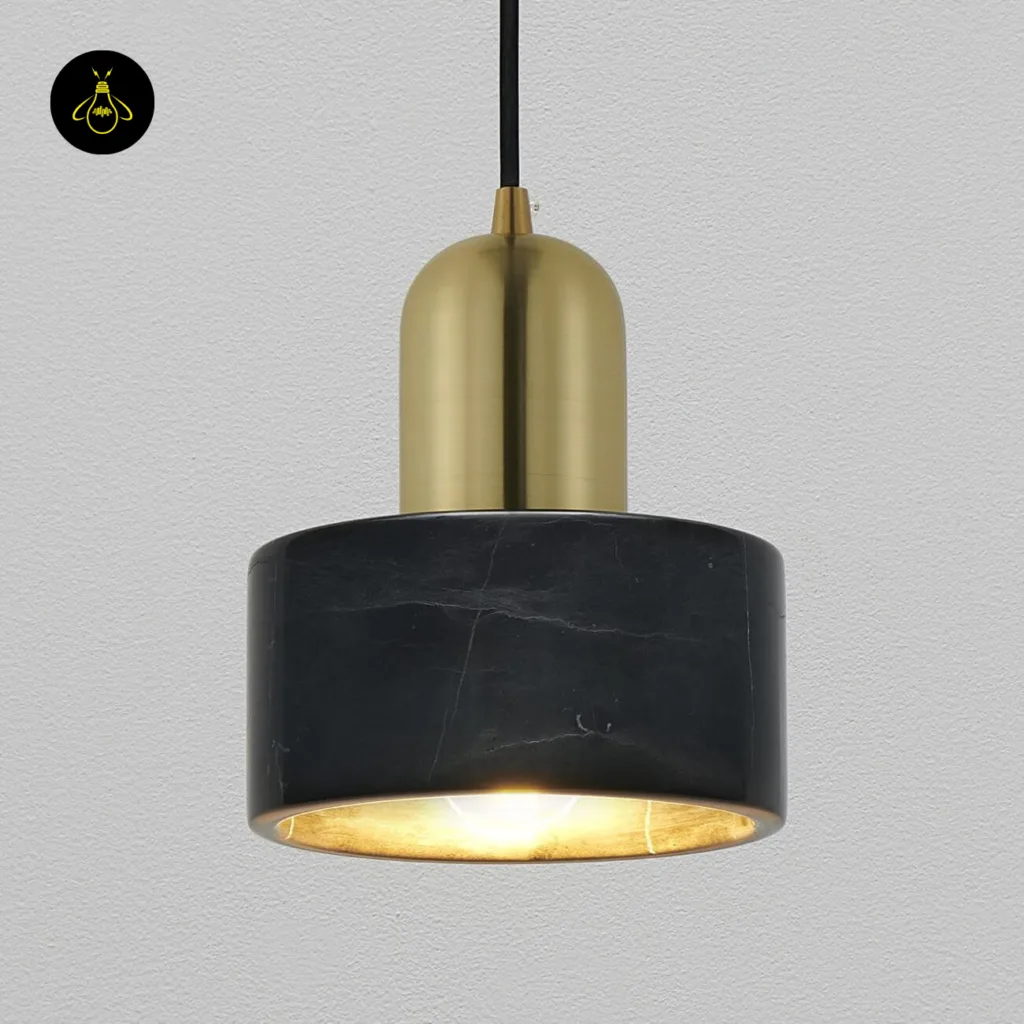
Marble and travertine are dense stones. Light does not glow through them like alabaster. The light falls from the open base, and its glow catches the stone around it.
For travertine, the craftsman cuts the piece, hones the outside and leaves the pits open. Honing means rubbing the stone smooth without making it shiny. Our travertine cylinder pendant is one slim tube of stone, 30 cm tall and 4 cm wide. Each tube has its own tone, from pale cream to honey.
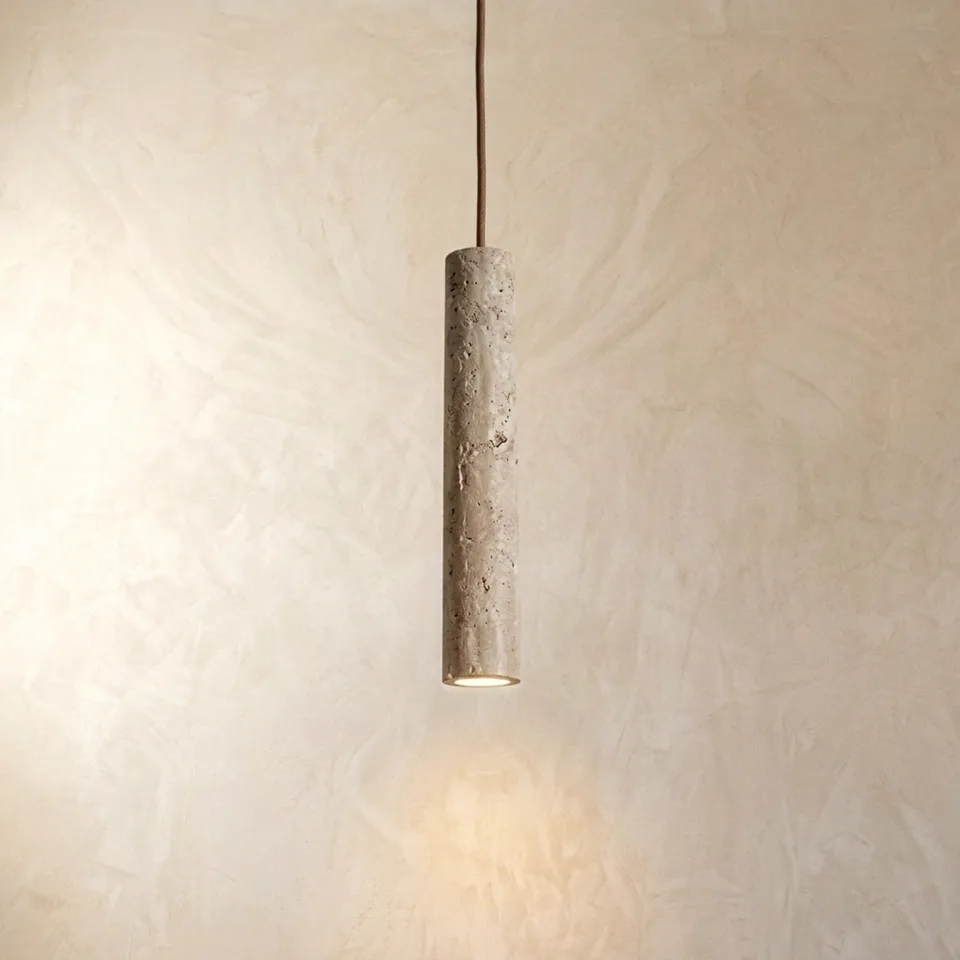
Behind each of these pieces are hours of patient human effort. The craftsman does not fight the pattern. He decides how to show it.
One of a kind is part of what you buy
Today 37 of our 453 lights use travertine and 17 use marble. You will find travertine most often in pendants and ceiling lights, and marble in table lamps, pendants and wall lights. See the full range in our travertine lighting collection.
Two lights of the same design share the same shape and size. Their stone never matches line for line.
So your light will differ a little from the photo. The veins will run a new way. The pits will sit in new places. We see this as proof that the stone is real. Natural variation is character, not a flaw.
The same rule holds when we make a light to your size. Our custom lights come in real marble and travertine too. We never use a print or a coating made to look like stone.
Natural stone also brings the earth element into a room. Vastu thinking has long valued that kind of harmony. We take it as inspiration, not as a promise.
Stone takes its pattern from the earth. Wood takes its pattern from the years a tree grows. In the next post, we turn to natural wood.
FAQs
Is travertine a type of marble?
No. Travertine is a kind of limestone formed by mineral spring water. Shops often call it “travertine marble”, but marble forms in a different way, under heat and pressure deep in the earth.
Does light pass through marble and travertine?
No, not in the way it passes through alabaster. The marble and travertine in our lights are dense, so the light falls from an open base and lights up the stone around it.
Will my stone light look exactly like the photo?
No. The shape, size and colour family will match the photo. The veins, pits and bands will differ a little, because each light is cut from its own piece of natural stone.
Nature gives the material.
Human hands give it meaning.
Vastu inspires harmony.
Light brings it to life.
That is JagMag.
With you.
Read next: Natural wood: how a tree’s grain lives on in our lights
See real stone up close: explore our alabaster and stone ceiling lights →